Water Damage Restoration Cost in Savannah, GA: What Homeowners Need to Know in 2025
Water Damage Restoration Cost in Savannah, GA: What Homeowners Need to Know in 2025
Water damage restoration in Savannah, GA typically costs between $1,300 and $6,384, with an average of roughly $2,200 based on completed local projects. Major multi-room floods or black water events can push totals to $15,000 or more. Savannah’s subtropical humidity, coastal flood exposure, and aging housing stock make fast response the single biggest factor in controlling your final bill.
If you’ve just found standing water in your home, every hour matters more in Savannah than in most American cities. The region’s notoriously high outdoor humidity, regularly topping 70 percent through the summer months, slows the drying process, extends equipment rental time, and accelerates the escalation of water from a manageable Category 1 clean-water event into a far more costly Category 2 or Category 3 situation. Understanding exactly what drives those costs, and what Savannah-specific conditions inflate them, puts you in the best possible position to make fast, informed decisions. Water Damage Restoration professionals who know Chatham County’s unique climate and building stock can make a measurable difference in how much you ultimately spend.
What Does Water Damage Restoration Cost in Savannah, GA?
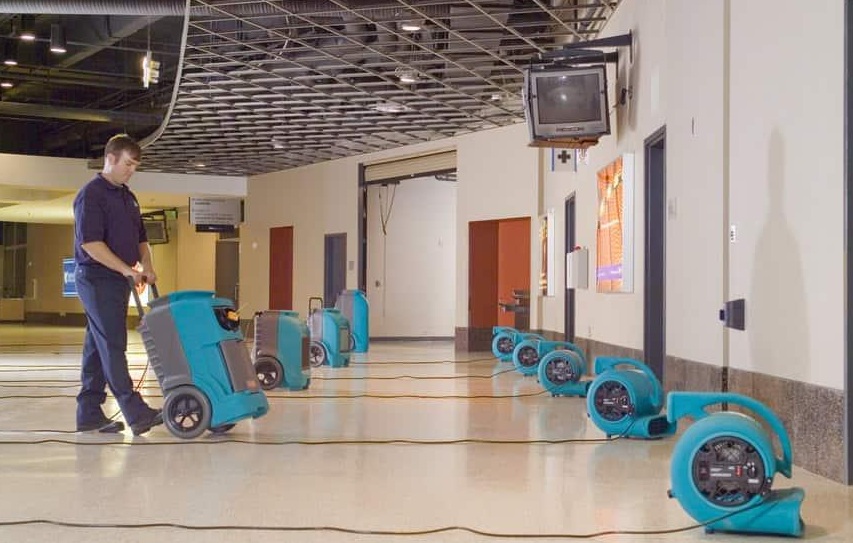
Savannah restoration costs fall into three broad tiers that mirror national industry breakdowns, though local conditions push the averages slightly upward for moderate and major losses.
| Damage Tier | Savannah Cost Range | Typical Scenario |
|---|---|---|
| Basic (minor, single area) | $1,300 to $2,500 | Small supply-line leak, limited drywall, one room |
| Moderate (one to two rooms) | $2,500 to $6,384 | Appliance failure, roof leak, bathroom overflow |
| Major (multi-room or structural) | $6,384 to $15,000+ | Storm flooding, sewage backup, hurricane water intrusion |
Data from completed projects in the Savannah area puts the average water damage repair cost at $2,168 to $2,246, based on a sample of roughly 28 to 29 local jobs. Nationally, HomeAdvisor reports the average at $3,833, with most homeowners spending between $1,364 and $6,301. Savannah tends to track slightly below the national average in project totals, consistent with the city’s near-par cost of living, but coastal flooding events and humidity-driven complications can quickly push local projects to the high end of any range.
Per-Square-Foot Cost Breakdown by Water Category
The industry divides water events into three categories based on contamination level, and those categories drive per-square-foot pricing more than almost any other single factor.
Category 1 (clean water) comes from broken supply lines, overflowing sinks, or rainwater. Mitigation runs approximately $3.50 to $4.00 per square foot. This is the most forgiving scenario, but only if addressed within 24 to 48 hours. In Savannah’s humidity, clean water sitting in wall cavities begins absorbing ambient moisture and bacterial load within that window, escalating to Category 2.
Category 2 (gray water) includes discharge from washing machines, dishwashers, or toilet overflows without solid waste. Per-square-foot costs rise to $5.25 to $6.50 for mitigation, reflecting the additional disinfection and containment protocols required.
Category 3 (black water) covers sewage backups, floodwater from rivers or storm surge, and any water that has been standing long enough to become heavily contaminated. Costs reach $7.00 to $7.50 per square foot for mitigation alone. Repair and rebuild costs, once the structure is dried and cleared, jump to $20 to $37 per square foot depending on finishes and structural involvement.
What Factors Affect the Cost of Water Damage Restoration?
Several variables interact to determine where your project lands within these ranges, and Savannah homeowners face a distinct combination of them.
Speed of Response
Calling within hours rather than days is the most powerful cost-control lever available to you. A Category 1 event that sits untreated for 48 hours in a Savannah home, where indoor humidity rarely drops below 60 percent even with air conditioning running, becomes a Category 2 event requiring decontamination, antimicrobial treatment, and more aggressive drying protocols. The cost difference between a same-day response and a 72-hour delay on a moderate loss can easily run $1,500 to $3,000 in additional mitigation work alone, before a single piece of drywall is replaced.
Extent and Class of Damage
Restoration professionals also classify damage by how deeply it has penetrated materials, from Class 1 (minimal absorption, affects a small area) to Class 4 (deep saturation of dense materials like hardwood subfloors, concrete, or plaster). Class 4 damage requires specialty low-grain refrigerant drying equipment and significantly longer drying cycles, both of which add to your total.
Savannah’s Humidity and Extended Drying Times
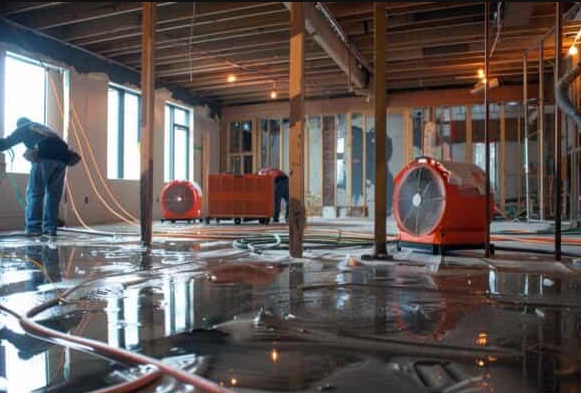
This is the factor most cost guides ignore entirely. National averages assume a drying time of roughly three to five days for water extraction and structural drying. In Savannah, where summers run long and the outdoor dew point regularly exceeds 70 degrees Fahrenheit, drying times can stretch to seven days or more even with industrial dehumidifiers running continuously. Each additional day of equipment on-site adds rental and labor cost. A project that would close in four days in Phoenix, Arizona might run seven or eight days in Savannah during July, meaningfully inflating the mitigation line item on your invoice.
Historic Home Premiums
Savannah has one of the largest concentrations of historic residential architecture in the American South. If your home falls within a historic district or is individually listed, restoration work is subject to review by the Metropolitan Planning Commission and must use materials and methods compatible with the original construction. Heart pine flooring cannot simply be replaced with standard-grade lumber. Original plaster walls require different repair techniques than modern drywall. Galvanized plumbing, common in pre-1960s homes throughout the city, corrodes from the inside out and may require full replacement once water access is gained. Expect a premium of 15 to 30 percent on top of standard restoration costs for a certified historic property.
Saltwater and Pluff Mud Intrusion
This is a cost factor almost entirely unique to Savannah and the surrounding Lowcountry. When storm surge or tidal flooding pushes saltwater and pluff mud, the dark, sulfuric marsh sediment characteristic of the Georgia coast, into a home, the decontamination process is substantially more intensive than standard Category 3 black water protocols. Salt accelerates corrosion in metal fasteners, electrical fixtures, and HVAC components. Pluff mud carries elevated hydrogen sulfide content and requires specialized biohazard disposal. If your home is near the Vernon River, Little Ogeechee River, Tybee Island, Wilmington Island, Isle of Hope, or any of the tidal communities in Chatham County, discuss saltwater intrusion protocols and their cost implications with your contractor before signing a work authorization.
Savannah Neighborhoods With Elevated Flood and Water Damage Risk
According to flood risk data, approximately 77 percent of buildings in Savannah are at risk of flooding, with the average at-risk structure facing roughly a 63 percent chance of a flood event reaching about 4.9 feet over a 30-year period. That is an unusually high baseline. Annual precipitation is projected to increase from approximately 51.1 inches to 53.5 inches as climate patterns shift.
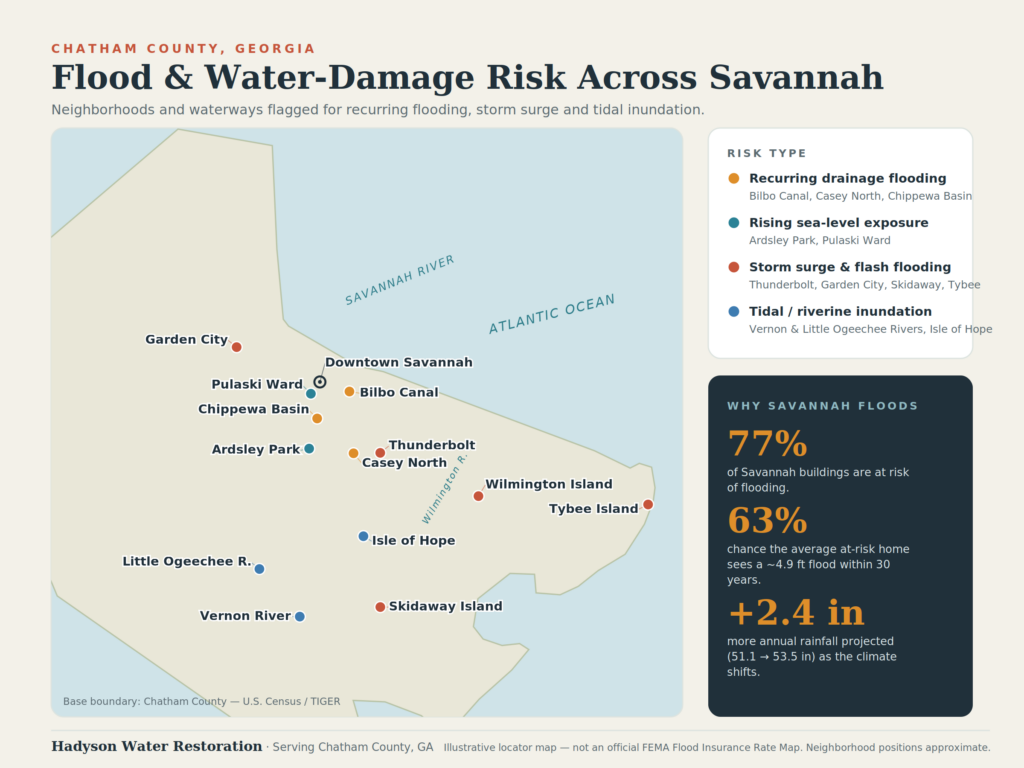
Within the city, neighborhoods near Bilbo Canal, Casey North, and Chippewa Basin are specifically flagged by city planners for recurring drainage problems. Ardsley Park and Pulaski Ward face escalating risk from rising sea levels, while properties adjacent to the Vernon and Little Ogeechee Rivers experience seasonal riverine inundation. Further out in Chatham County, communities including Thunderbolt, Garden City, Skidaway Island, and coastal areas near Tybee Island carry elevated exposure to both storm surge and flash flooding.
Homeowners in these areas should factor water damage restoration budgeting into their long-term financial planning, not treat it as a one-time emergency expense. Repetitive loss properties in Chatham County are well documented in NFIP records, and the frequency of claims in these zones reflects a structural geographic reality rather than isolated bad luck.
You can view the service area and local context on the Savannah GA location listing to understand coverage across these neighborhoods.
Does Homeowners Insurance Cover Water Damage Restoration?
The answer depends entirely on the source of the water. Standard homeowners insurance generally covers sudden and accidental water damage events, such as a burst pipe, a failed appliance water supply line, or an unexpected roof leak during a rainstorm. It does not cover gradual damage from a slow leak you should have noticed and repaired, and it does not cover flooding.
Flood damage, defined as water entering the home from an external source such as storm surge, rising rivers, or sheet runoff, requires a separate flood insurance policy, typically purchased through the National Flood Insurance Program. This distinction catches many Savannah homeowners off guard after a hurricane or heavy rain event. If the water came from the sky and through your roof, it may be covered. If it came in through the door because the street flooded, it almost certainly is not covered without a separate NFIP or private flood policy.
A meaningful bright spot for Chatham County residents: the county voluntarily participates in FEMA’s Community Rating System, which earns policyholders in mandatory flood insurance areas (A, AE, and VE flood zones) a 25 percent discount off their NFIP flood insurance premium, saving approximately $263 per policyholder annually. If you carry flood insurance and have not had your premium reviewed recently, confirm you are receiving this CRS discount.
Do You Need a Permit to Repair Water Damage in Savannah, GA?
Yes, in most cases involving structural repair. The City of Savannah’s Development Services Department requires permits for work that goes beyond simple cosmetic repairs. Common permits for water damage restoration projects include a Building Permit for structural framing and finish work, a Plumbing Permit for any pipe replacement or rerouting, a Mechanical Permit for HVAC and ductwork repairs, an Electrical Permit for any wiring that gets disturbed or replaced, and a Demolition Permit when significant tearout is required.
All work must comply with the City of Savannah Construction and Life Safety Codes, which align with the state minimum codes adopted by Georgia’s Department of Community Affairs. For specific questions about permit requirements on your project, the Development Services Department can be reached at 912-651-6530. Budget one to two weeks for permit processing into your project timeline, and be aware that permitted work adds a modest cost, typically a few hundred dollars in fees, but protects you legally and ensures the work passes final inspection, which matters significantly at resale.
How Much Does Mold Remediation Cost After Water Damage?
Mold remediation is the most common add-on cost after water damage in Savannah, and it is nearly unavoidable if drying was delayed or incomplete. The national average for mold remediation runs approximately $2,300, though scope varies considerably. Small isolated patches in a single bathroom might cost $500 to $1,000. A whole-house mold event following a major flood can exceed $10,000.
Savannah’s combination of warmth, humidity, and aging building cavities makes mold growth extremely rapid following water intrusion. Spores can colonize wet drywall paper within 24 to 48 hours under local climate conditions. If there is any possibility that water reached concealed cavities, wall interiors, or subfloor spaces, a moisture mapping inspection before closing out the restoration job is worth the cost.
How Long Does Water Damage Restoration Take?
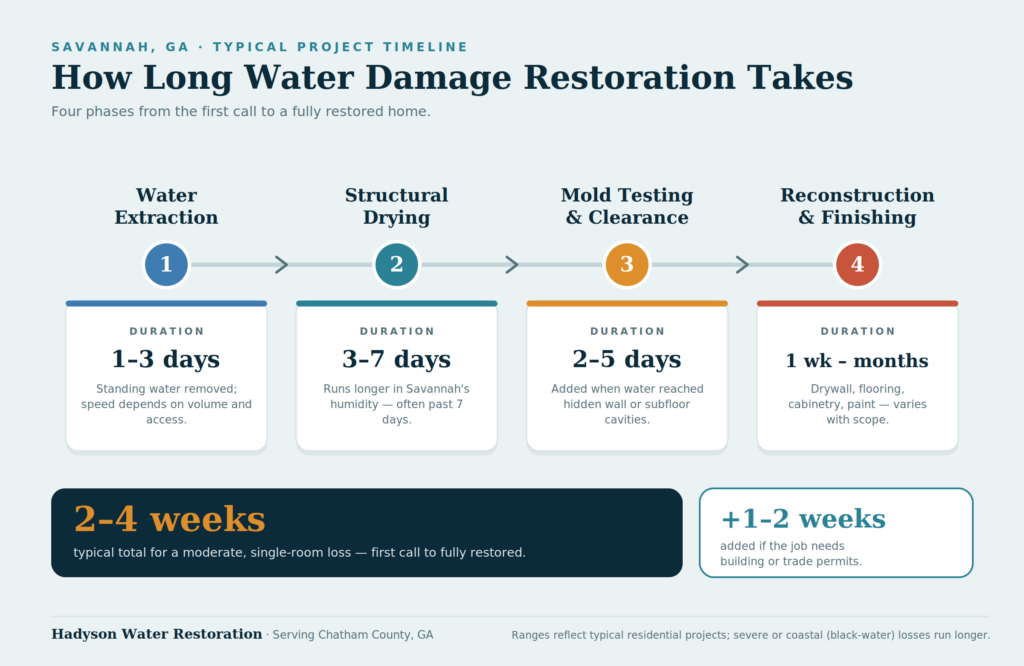
A complete water damage restoration project moves through several distinct phases. Water extraction typically takes one to three days depending on volume and access. Structural drying, the phase most affected by Savannah’s humidity, runs three to seven days under normal conditions and can extend further in severe cases or during peak summer months. Mold testing and clearance, if required, adds two to five days. Reconstruction and finishing, replacing drywall, flooring, cabinetry, and paint, can run from one week to several months depending on scope. A realistic total timeline for a moderate single-room loss is two to four weeks from the initial call to a fully restored space.
For a project large enough to require permits, add the permit processing timeline to that estimate. In Chatham County’s building department, processing typically runs one to two weeks for standard residential permits.
If you are ready to move forward or want a professional assessment of your situation, the fastest next step is to Contact a local restoration specialist who can walk your property and give you a scope-specific number rather than a range.
FAQ: Water Damage Restoration Costs in Savannah, GA
How much does water damage restoration cost in Savannah, GA?
In Savannah, water damage restoration typically costs between $1,300 and $6,384, with local project averages landing around $2,200 based on completed jobs. Minor clean-water events at the low end and major multi-room floods or black water events can push totals from $450 up to $15,000 or more, depending on scope, water category, and speed of response.
What factors affect the cost of water damage restoration?
The key drivers are the category of water involved (clean, gray, or black), the class of damage indicating how deeply materials are saturated, the total square footage affected, speed of response, and local conditions. In Savannah specifically, high humidity extends drying timelines, historic home construction adds material premiums, and coastal flood events may introduce saltwater or pluff mud requiring specialized decontamination protocols.
Does homeowners insurance cover water damage restoration?
Standard homeowners insurance covers sudden, accidental water damage such as burst pipes or appliance failures, but excludes gradual leaks and flood damage. Flood damage from storm surge or rising water requires a separate NFIP or private flood policy. Chatham County’s CRS participation gives qualifying policyholders a 25 percent NFIP premium discount, saving roughly $263 annually per policy.
How long does water damage restoration take in Savannah?
Extraction takes one to three days, structural drying runs three to seven days (longer in Savannah’s summer humidity), and reconstruction can take one week to several months depending on scope. A typical moderate loss from start to a finished, restored space runs two to four weeks total. Permits add one to two weeks to the timeline for projects requiring structural or trade work.
Do I need a permit to repair water damage in Savannah, GA?
Yes, for most structural, plumbing, electrical, or mechanical repairs. The City of Savannah’s Development Services Department issues Building, Plumbing, Mechanical, Electrical, and Demolition permits for water damage work. Permit fees typically add a few hundred dollars to project cost but are legally required and protect your rights at resale. Call 912-651-6530 with project-specific questions.
What is the difference between Category 1, 2, and 3 water damage?
Category 1 is clean water from supply lines or rain, costing roughly $3.50 to $4.00 per square foot to mitigate. Category 2 is gray water from appliances or toilet overflow without solids, running $5.25 to $6.50 per square foot. Category 3 is black water from sewage or floodwater, costing $7.00 to $7.50 per square foot or more, with rebuild costs reaching $20 to $37 per square foot.
Water damage moves fast in Savannah’s climate, and the gap between a manageable repair bill and a major financial loss often comes down to the first few hours after discovery. Hadyson Water Restoration serves homeowners throughout Chatham County with local expertise, rapid response, and a clear understanding of the neighborhood-level risks, historic home challenges, and coastal conditions that make Savannah a uniquely demanding environment for water damage work. Reach out today for an honest assessment before the drying clock runs any further.