Mold Remediation Cost in Savannah, GA: What Homeowners Need to Know
Mold remediation in Savannah, GA typically costs between $1,225 and $3,753, with most homeowners paying an average of around $2,368 for a moderate single-room problem. Whole-house infestations following flooding or a long-standing leak can push totals past $10,000, and in extreme cases $30,000. Savannah’s year-round humidity, coastal flood exposure, and large stock of older homes make the city one of the most mold-prone environments in the country, which means local costs are driven as much by climate as by the size of the visible growth.
If you’ve just spotted mold on a baseboard, a ceiling corner, or inside a closet, you’re looking at a problem that behaves very differently here than it does in a drier climate. Savannah’s outdoor humidity regularly tops 70 percent through the long summer, and indoor relative humidity in many homes rarely drops below 60 percent even with the air conditioning running. Those conditions let mold colonize damp drywall, insulation, and framing within 24 to 48 hours, and they make it spread faster and farther than national cost guides assume. Understanding exactly what drives remediation pricing, and which Savannah-specific factors inflate it, puts you in the best position to make a fast, informed decision. Hadyson Water Restoration works with Chatham County’s unique climate and building stock every day, and that local knowledge can make a measurable difference in what you ultimately pay.
What Does Mold Remediation Cost in Savannah, GA?
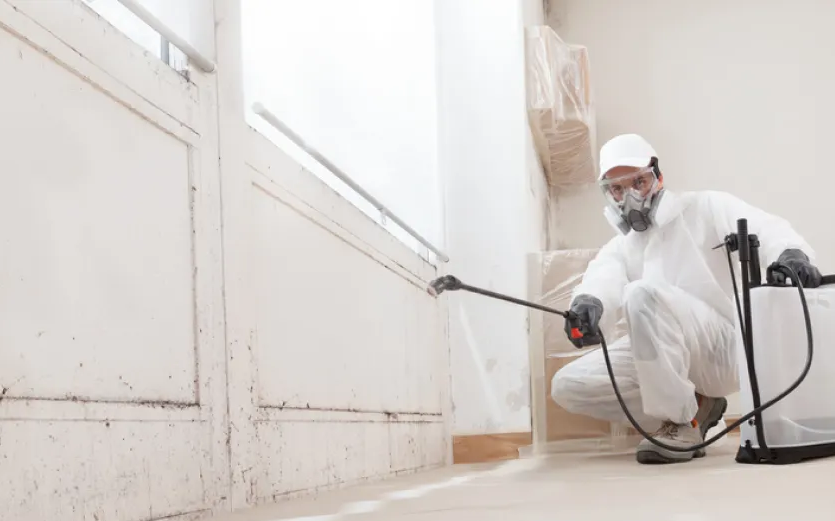
Mold remediation costs fall into a few broad tiers that track national industry data, though Savannah’s humidity and coastal conditions tend to push jobs toward the higher end of each range.
| Project Scope | Savannah Cost Range | Typical Scenario |
|---|---|---|
| Small (isolated patch, one area) | $500 to $1,500 | Bathroom corner, under a sink, a single closet wall |
| Moderate (one to two rooms) | $1,500 to $6,000 | Behind drywall after a leak, HVAC-fed spread, laundry room |
| Major (multi-room, structural, attic) | $6,000 to $30,000+ | Whole-house flood aftermath, crawl space, attic sheathing |
Nationally, HomeAdvisor puts the average mold remediation cost at roughly $2,368, with most homeowners spending between $1,225 and $3,753. Professionals generally price the work at $10 to $25 per square foot of affected area, covering containment, removal, cleaning, and disposal. Savannah projects frequently land in the upper portion of these ranges because the warm, wet climate tends to produce deeper, more concealed growth than the visible surface patch a homeowner first notices.
Per-Square-Foot Cost Breakdown by Severity
Square footage is the single biggest cost driver, but the depth and location of the growth matter just as much as the area it covers.
Surface mold (minor, non-porous). Growth on tile, sealed concrete, or a small patch of painted drywall that hasn’t penetrated the material runs toward the lower end, roughly $10 to $15 per square foot. A 50-square-foot bathroom problem caught early often closes out for $500 to $1,500 total.
Embedded mold (porous materials). Once mold is inside drywall paper, insulation, carpet padding, or wood framing, the affected material has to be removed and replaced rather than just cleaned. Per-square-foot costs climb to $15 to $25, and demolition and rebuild are billed separately on top of the remediation itself.
Concealed and structural mold. Growth inside wall cavities, subfloors, attic sheathing, or a crawl space is the most expensive scenario because it requires containment, negative-air filtration, specialized access, and often structural repair. These jobs regularly exceed $6,000 and, for a whole-house event, can reach $10,000 to $30,000.
What Factors Affect the Cost of Mold Remediation?
Several variables interact to determine where your project lands, and Savannah homeowners face a distinct combination of them.
Size and Location of the Growth
A 10-square-foot patch in an accessible bathroom is a fundamentally different project from mold spread across 500 square feet of a crawl space. The EPA recommends that any mold covering more than about 10 square feet be handled by a professional. Location compounds the cost: mold inside an HVAC system or ductwork can run $3,000 to $10,000 because it spreads spores throughout the home and requires the entire system to be cleaned or replaced.
Savannah’s Humidity and the Speed of Spread
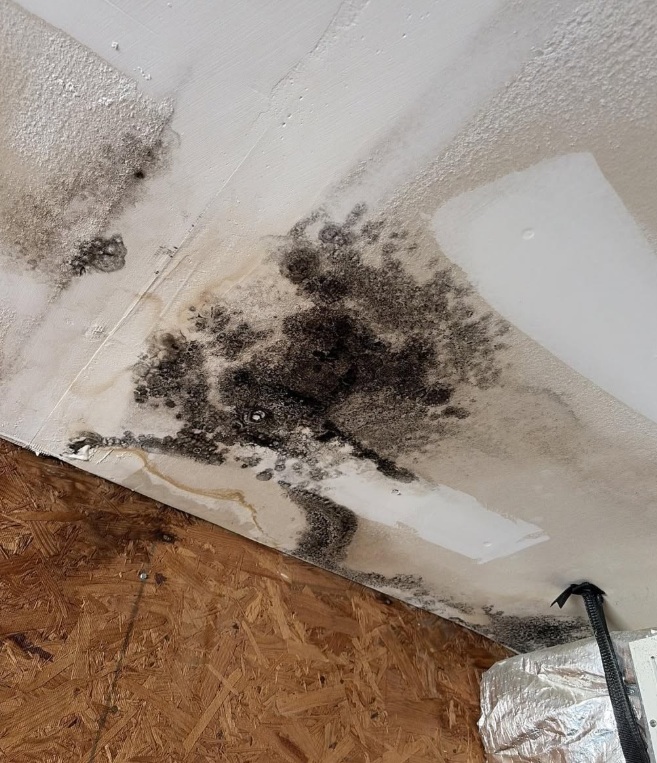
This is the factor most national cost guides ignore entirely. In a drier climate, a small leak might produce a contained patch you can address at your leisure. In Savannah, where the summer dew point regularly exceeds 70 degrees Fahrenheit, mold spores colonize wet material within 24 to 48 hours and keep spreading as long as ambient moisture stays high. A problem that looks like a one-room job when you first see it has often already reached adjacent wall cavities. Catching it early is the most powerful cost-control lever you have, and it’s why Hadyson Water Restoration emphasizes fast moisture mapping before quoting a scope.
Hidden Moisture Source
Remediation that removes the mold without fixing the moisture feeding it will fail, and you’ll pay twice. Identifying and correcting the source, a slow plumbing leak, a failed roof flashing, poor crawl space ventilation, or condensation on cold-water lines, is part of any legitimate job. In Savannah’s climate, humidity control (dehumidification, vapor barriers, improved drainage) is frequently the difference between a permanent fix and a recurring problem.
Historic Home Premiums
Savannah has one of the largest concentrations of historic residential architecture in the American South, and these homes present unique mold challenges. Original plaster walls, heart pine flooring, and galvanized plumbing all behave differently than modern materials when they get wet. Homes in a designated historic district are subject to review by the Metropolitan Planning Commission, and repairs must use compatible materials and methods, which raises both material and labor costs. Expect a premium of roughly 15 to 30 percent on top of standard remediation for a certified historic property.
Crawl Spaces, Pluff Mud, and Coastal Moisture
Many Savannah and Lowcountry homes sit on crawl space or pier foundations exposed to ground moisture and, in low-lying areas, to tidal influence. Crawl space mold remediation commonly runs $1,500 to $5,000 on its own, and the work is more involved near the water. When storm surge or tidal flooding pushes saltwater and pluff mud, the dark, sulfuric marsh sediment characteristic of the Georgia coast, under or into a home, the moisture and organic load left behind feed aggressive mold growth that standard protocols don’t fully address. Properties near the Vernon River, Little Ogeechee River, Tybee Island, Wilmington Island, or Isle of Hope should factor this elevated exposure into their budgeting.
Savannah Neighborhoods With Elevated Moisture and Mold Risk
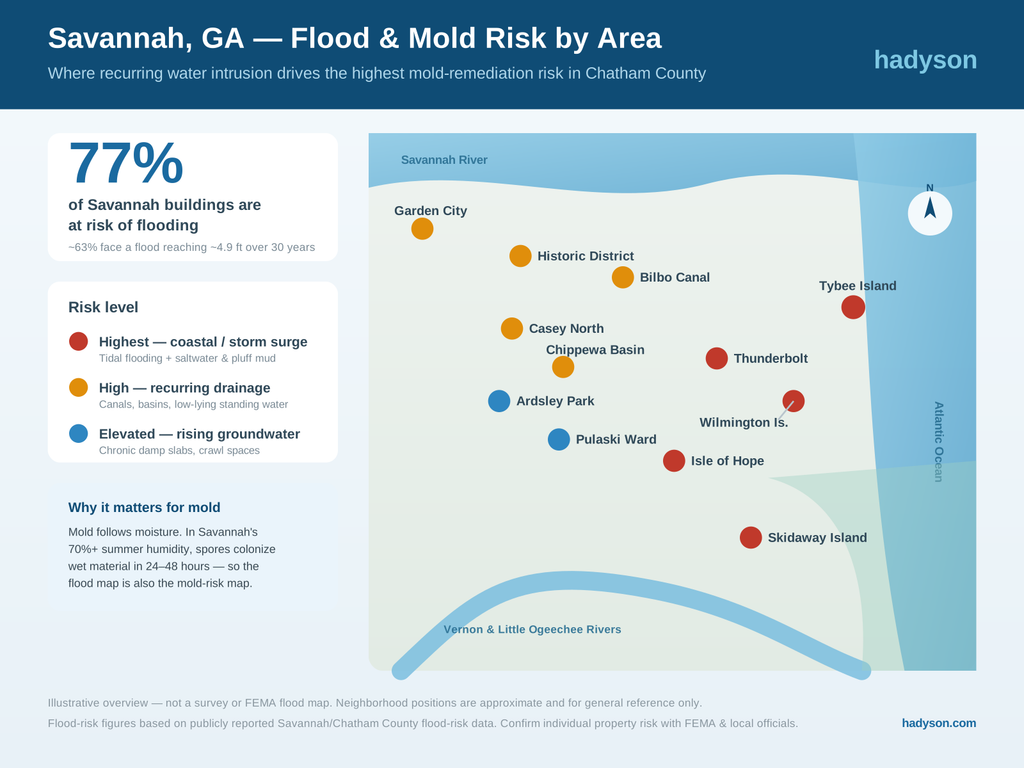
Because mold follows water, the same geography that drives Savannah’s flood risk drives its mold risk. According to flood risk data, roughly 77 percent of buildings in Savannah are at risk of flooding, an unusually high baseline that translates directly into repeated moisture intrusion and recurring mold problems in the hardest-hit areas.
Within the city, neighborhoods near Bilbo Canal, Casey North, and Chippewa Basin are flagged by planners for recurring drainage problems that keep soil and foundations damp. Ardsley Park and Pulaski Ward face escalating risk from rising groundwater, while properties adjacent to the Vernon and Little Ogeechee Rivers deal with seasonal inundation that leaves crawl spaces and ground floors chronically moist. Further out in Chatham County, communities including Thunderbolt, Garden City, Skidaway Island, and the coastal areas near Tybee Island carry elevated exposure to the standing water and high humidity that mold needs to thrive.
Homeowners in these areas are better served treating mold prevention as ongoing maintenance, controlling indoor humidity, maintaining crawl space vapor barriers, and addressing leaks immediately, rather than waiting for a visible outbreak. You can view the service area and local context on the Savannah, GA location listing to understand coverage across these neighborhoods.
Does Homeowners Insurance Cover Mold Remediation?
Sometimes, and the answer hinges on what caused the mold. Standard homeowners insurance generally covers mold remediation only when it results from a sudden, accidental, and covered event, such as a burst pipe or an appliance failure that was promptly addressed. In those cases, insurers often cap mold coverage at a specific limit, commonly $1,000 to $10,000, regardless of the actual remediation cost.
What insurance almost never covers is mold caused by gradual leaks, long-term humidity, deferred maintenance, or flooding. If an adjuster determines the mold grew because a leak went unaddressed, the claim is typically denied. And because flood damage requires a separate policy through the National Flood Insurance Program, mold that follows storm surge or rising water is generally only covered if you carry flood insurance and the policy addresses the resulting mold. For Savannah homeowners, this distinction matters enormously: a hurricane that drives water into your home can leave you with a major mold problem that standard homeowners coverage won’t touch. Document the moisture source thoroughly, and file any claim quickly.
Do You Need a Permit for Mold Remediation in Savannah, GA?
Mold remediation itself usually does not require a permit, but the repair work that follows often does. The City of Savannah’s Development Services Department requires permits once remediation moves into structural territory, a Building Permit for framing and drywall replacement, a Plumbing Permit if pipes are repaired or rerouted to fix the moisture source, a Mechanical Permit for HVAC and ductwork, and an Electrical Permit if wiring is disturbed during tearout.
All work must comply with the City of Savannah Construction and Life Safety Codes, which align with Georgia’s state minimum codes. For project-specific questions, the Development Services Department can be reached at 912-651-6530. Permit fees typically add a few hundred dollars and one to two weeks to the timeline, but they protect you legally and ensure the repair passes inspection, which matters at resale, especially since a documented, permitted mold remediation is far easier to disclose to a future buyer than an unpermitted one.
How Much Does Mold Testing and Post-Remediation Verification Cost?
Testing is a separate line item worth understanding. Pre-remediation inspection and air or surface sampling to identify the type and extent of mold typically runs $200 to $700. After the work is done, post-remediation verification, a clearance test confirming spore counts have returned to normal, usually costs $150 to $1,200 depending on the number of samples.
In Savannah’s climate, that clearance test is more than a formality. Because concealed moisture is so common here, verification is the only reliable way to confirm that mold hasn’t simply retreated into a wall cavity to return in a few weeks. If a remediation quote doesn’t mention clearance testing at all, ask about it before signing.
How Long Does Mold Remediation Take?
A typical mold remediation project moves through several phases. Inspection and moisture mapping take one day. Containment setup and the removal and cleaning of affected materials run two to five days for a moderate job, longer if growth is extensive or concealed. Drying and dehumidification, the phase most affected by Savannah’s humidity, can add several days because ambient moisture slows the process. Post-remediation testing adds one to three days for sampling and lab results, and reconstruction, replacing drywall, flooring, and finishes, can run from a few days to several weeks depending on scope.
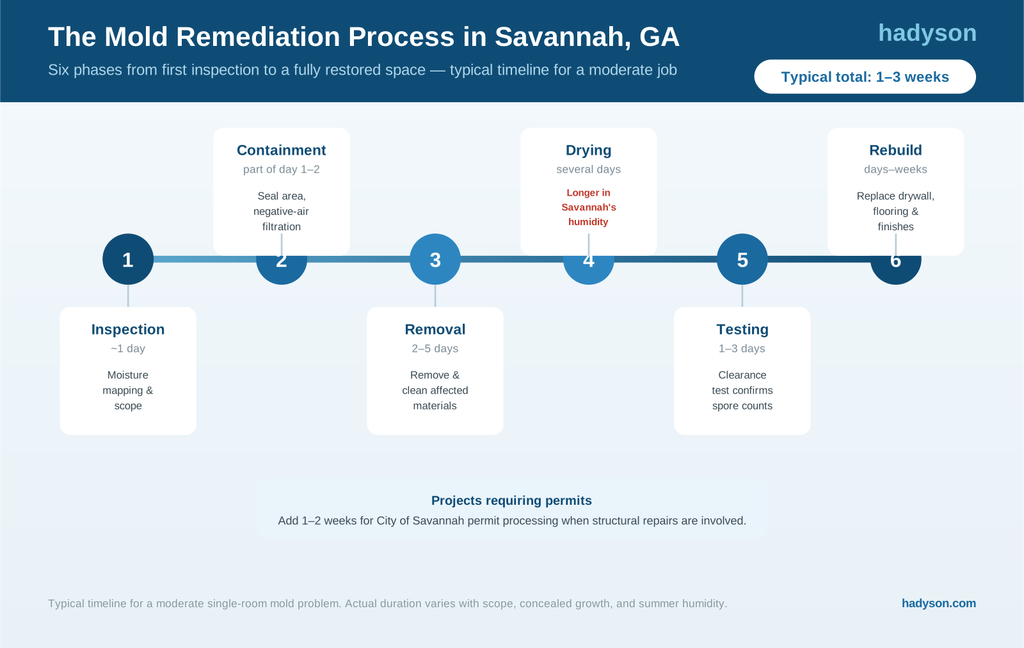
A realistic total for a moderate single-room mold problem is one to three weeks from inspection to a fully restored space. For projects large enough to require permits, add the one-to-two-week processing window. If you want a scope-specific number rather than a range, the fastest next step is to Contact a local specialist who can walk your property and assess the hidden moisture that drives most of the cost.
FAQ: Mold Remediation Costs in Savannah, GA
How much does mold remediation cost in Savannah, GA?
In Savannah, mold remediation typically costs between $1,225 and $3,753, with an average around $2,368 for a moderate single-room problem. Small isolated patches run $500 to $1,500, while whole-house infestations following flooding can reach $10,000 to $30,000. Local humidity and concealed moisture tend to push Savannah projects toward the higher end of national ranges.
What factors affect the cost of mold remediation?
The biggest drivers are the size and location of the growth, how deeply it has penetrated materials, and whether it sits in hard-to-reach areas like crawl spaces, attics, or HVAC systems. In Savannah specifically, high humidity speeds the spread, historic home construction adds material premiums, and coastal moisture or pluff mud intrusion can require more intensive work than standard protocols.
Does homeowners insurance cover mold remediation?
Sometimes. Standard policies may cover mold caused by a sudden, accidental, covered event like a burst pipe, usually with a cap of $1,000 to $10,000. Mold from gradual leaks, long-term humidity, or deferred maintenance is typically excluded, and mold from flooding is only covered if you carry a separate NFIP or private flood policy that addresses it.
How long does mold remediation take in Savannah?
Inspection takes about a day, removal and cleaning run two to five days for a moderate job, and drying is extended by Savannah’s humidity. Post-remediation testing adds one to three days, and reconstruction varies by scope. A typical moderate single-room project runs one to three weeks total, with permits adding one to two weeks when structural repairs are involved.
Do I need a permit for mold remediation in Savannah, GA?
The remediation itself usually doesn’t require a permit, but the structural, plumbing, electrical, or mechanical repairs that follow often do. The City of Savannah’s Development Services Department issues these permits. Fees typically add a few hundred dollars, and you can reach the department at 912-651-6530 with project-specific questions.
Can I remove mold myself to save money?
For a small surface patch under about 10 square feet on a non-porous surface, careful DIY cleaning can work. Beyond that, the EPA recommends professional remediation, and in Savannah’s climate the risk of missing concealed, moisture-fed growth is high. Incomplete DIY work frequently leads to regrowth and a larger bill later, which is why professional moisture mapping and clearance testing usually pay for themselves.
Mold moves fast in Savannah’s climate, and the gap between a small, affordable cleanup and a major structural problem often comes down to how quickly the moisture source is found and corrected. Hadyson Water Restoration serves homeowners throughout Chatham County with local expertise, rapid response, and a clear understanding of the humidity, historic-home challenges, and coastal conditions that make Savannah, GA a uniquely demanding environment for mold work. Reach out today for an honest assessment before a small patch becomes a whole-house problem.